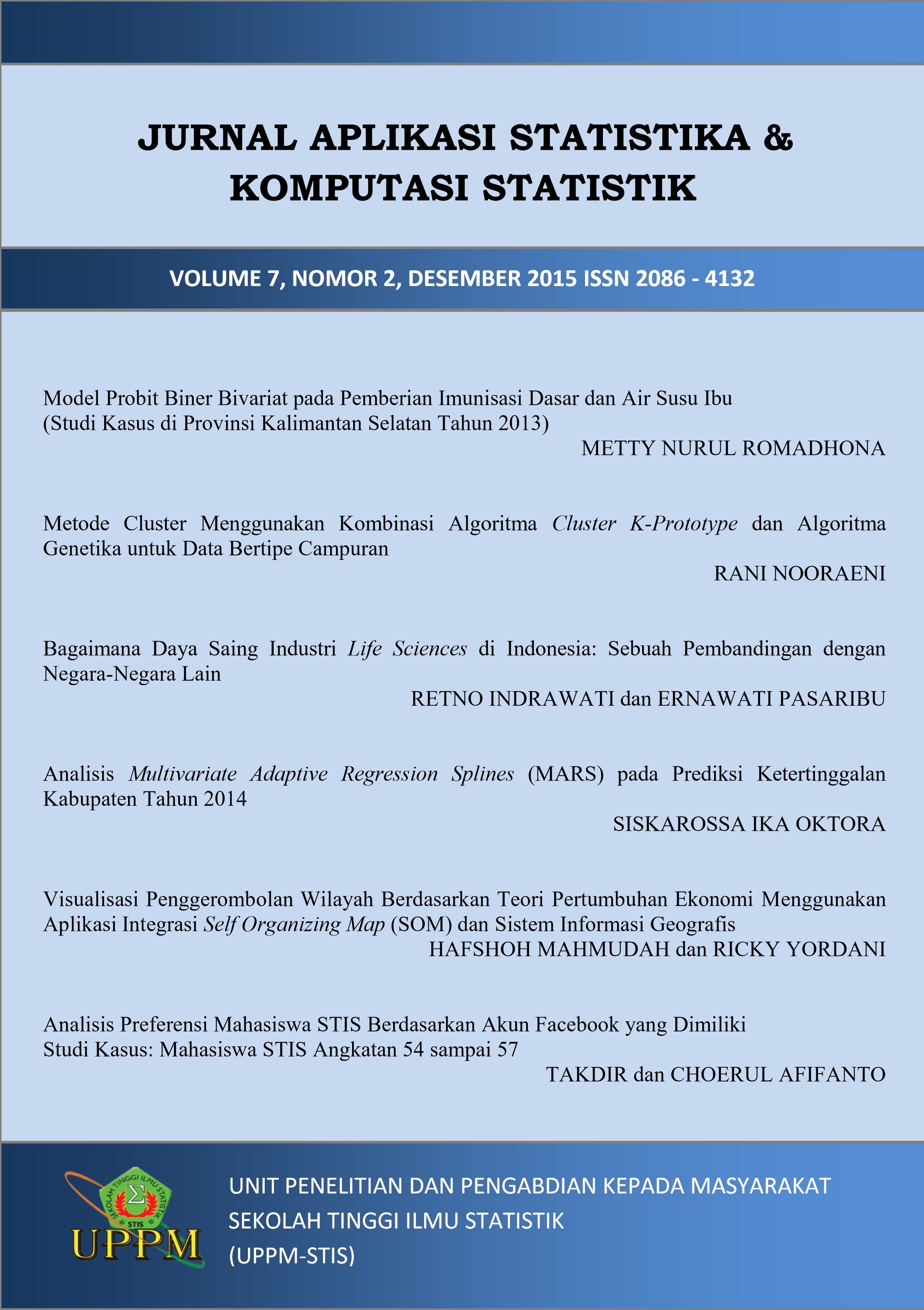
Visualization od Clustering Region by Economic Growth Theory Using The Integration Self Organizing Map (SOM) and Geographic Information System
DOI:
https://doi.org/10.34123/jurnalasks.v7i2.21Keywords:
Economic Growth Pole, Self Organizing Map, Cluster AnalysisAbstract
Economic growth is one of factor that is critical to determining the welfare of a region. However, differences in geographical conditions and the potential of the area led to differences in economic conditions differ between regions. The case studies conducted on Central Java Province because it is one of the largest contributors to GDP in Indonesia, which still has economic inequality between cities and between districts. To make more easy for visualize the economic growth, researcher then made an application that is able to easily see the effect of growth and clustering in the province of Central Java. There are many methods that can be used for cluster analysis. One of the most common methods used are the K-Means. However, K-Means has some drawbacks. One alternative method is using the Self Organizing Map (SOM) which is capable clustering accompanied by visualization of multidimensional data with techniques Unsupervised Artificial Neural Network. This application allows visualization and analysis because it is integrated with Geographic Information Systems (GIS). Applications are made subsequently used to analyze clustering with case study data of Central Java province. The resulting visualization capable of showing a pattern of economic growth in Central Java Province
Downloads