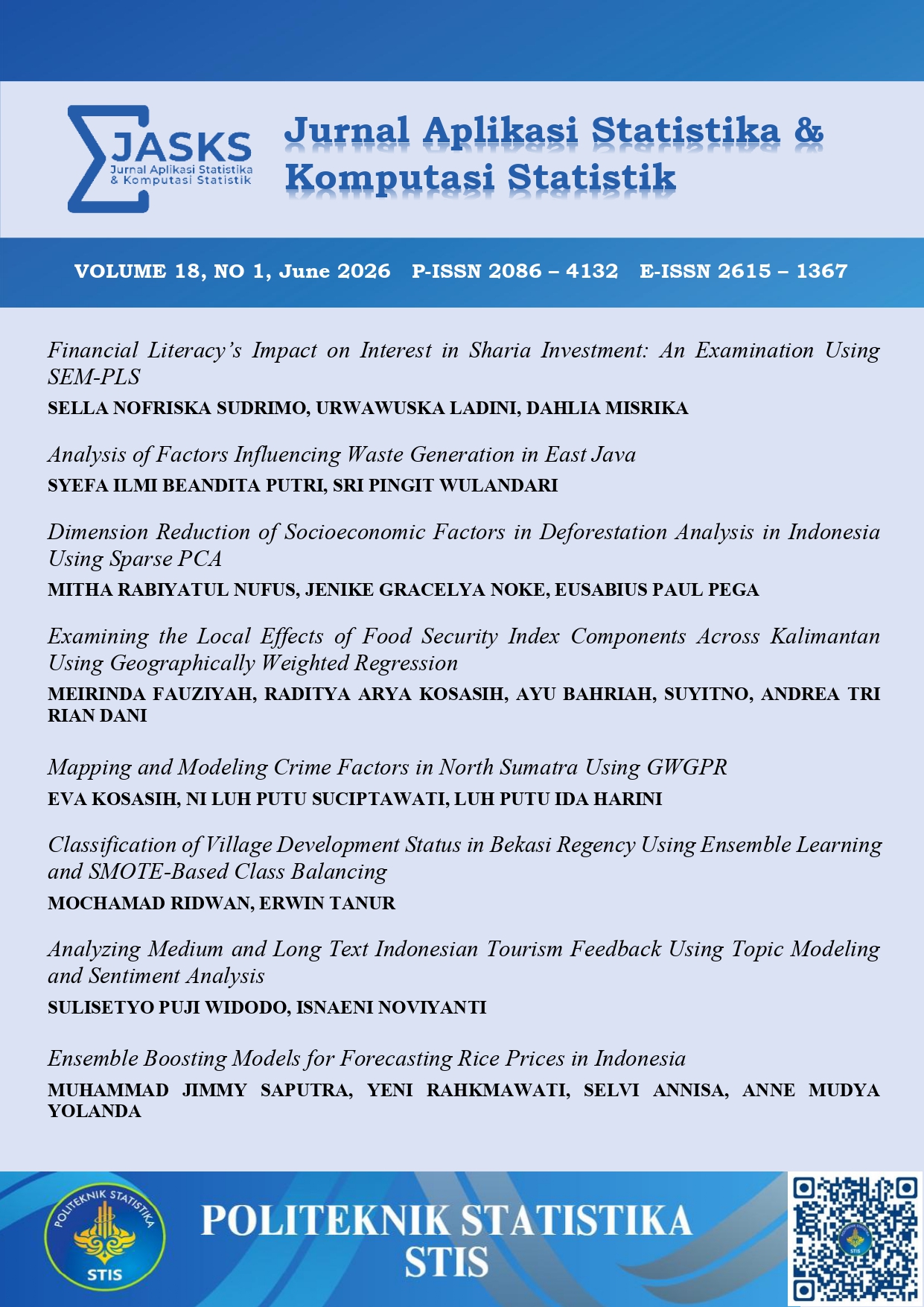
Financial Literacy’s Impact on Interest in Sharia Investment: An Examination Using SEM-PLS
DOI:
https://doi.org/10.34123/jurnalasks.v18i1.784Keywords:
Financial Inclusion, Financial Literacy, Sharia Investment, SEM-PLS, Southwest PapuaAbstract
Introduction/Main Objectives: This research explores the impact of financial literacy, including knowledge, confidence, and ability, on interest in Sharia investment. Background Problems: the relationship between financial literacy and interest in sharia investment. Novelty: Considering that each province has different community characteristics, especially in the Southwest Papua Province area which is included in the 3T areas (underdeveloped, frontier, and outermost), an analysis was carried out and using SEM-PLS for analysis of Ddta. Research Methods: Using the Structural Equation Model Partial Least Square (SEM-PLS) method with the response variable sharia investment interest and the financial literacy variable with the dimensions of knowledge, confidence and ability. Finding/Results: The results show that financial literacy has a positive and statistically significant effect on interest in Sharia investment. Although its explanatory power is limited (R² = 0.094), the findings indicate that financial literacy functions as an enabling factor rather than a sole determinant of Sharia investment interest. These results suggest that improving financial literacy alone is insufficient to substantially increase interest in Sharia investment. Therefore, policies aimed at promoting Sharia investment should integrate financial education with institutional trust-building, product accessibility, and socio-religious engagement, particularly in underdeveloped and frontier regions such as Southwest Papua.
Downloads
References
A. Lusardi and O. S. Mitchell, “The economic importance of financial literacy: Theory and evidence,” Journal of Economic Literature, vol. 52, no. 1, pp. 5–44, 2014, doi: 10.1257/jel.52.1.5.
A. Yulianto, “Pengaruh literasi keuangan syariah terhadap keputusan penggunaan produk atau layanan lembaga keuangan syariah,” Jurnal Ilmiah Ekonomi Syariah Pascasarjana (JIESP), vol. 2, no. 1, pp. 45–56, 2018. [Online]. Available: https://ejournal.kopertais4.or.id/susi/index.php/JIESP/article/download/3634/2470
E. N. Fitrianingsih, “Pengaruh literasi keuangan terhadap keputusan investasi mahasiswa Fakultas Ekonomi dan Bisnis Universitas Muhammadiyah Purwokerto,” Skripsi, IAIN Purwokerto, 2019. [Online]. Available: https://repository.uinsaizu.ac.id/6289/
M. Widiantika, “Pengaruh persepsi return, motivasi, literasi keuangan, dan pendapatan terhadap minat investasi pada mahasiswa Fakultas Ekonomi Universitas Negeri Jakarta,” Skripsi, Universitas Negeri Jakarta, 2022. [Online]. Available: https://repository.fe.unj.ac.id/10340/
L. Lutfi, A. Z. Arifin, and A. Syafii, “Sharia financial literacy and investment decisions among students,” Journal of Islamic Economics and Business, vol. 11, no. 2, pp. 103–118, 2021.
S. Wahyudi and H. Prasetyo, “Sharia-compliant financial literacy and its impact on investment interest,” Journal of Islamic Economics and Finance Studies, vol. 5, no. 1, pp. 25–36, 2023.
Sugiyono, Metode Penelitian Kuantitatif, Kualitatif, dan R&D. Bandung: Alfabeta, 2022.
J. F. Hair, G. T. M. Hult, C. M. Ringle, and M. Sarstedt, A Primer on Partial Least Squares Structural Equation Modeling (PLS-SEM), 2nd ed. Thousand Oaks, CA: Sage Publications, 2017.
J. F. Hair, G. T. M. Hult, C. M. Ringle, and M. Sarstedt, A Primer on Partial Least Squares Structural Equation Modeling (PLS-SEM), 3rd ed. Thousand Oaks, CA: Sage Publications, 2022.
J. Henseler, G. Hubona, and P. A. Ray, “Using PLS path modeling in new technology research: Updated guidelines”, Industrial Management & Data Systems, vol. 116, no. 1, pp. 2–20, 2015, doi: 10.1108/IMDS-09-2015-0382.
E. Babbie, The Practice of Social Research, 15th ed. Boston, MA: Cengage Learning, 2020.
M. Saunders, P. Lewis, and A. Thornhill, Research Methods for Business Students, 8th ed. Harlow, UK: Pearson Education, 2019.
I. Ghozali, Konsep dan Aplikasi Structural Equation Modeling berbasis Variance dengan Program SmartPLS 3.0. Semarang: Badan Penerbit Universitas Diponegoro, 2014.
M. Sarstedt, C. M. Ringle, and J. F. Hair, “Partial least squares structural equation modeling: Guidelines and advances,” European Business Review, vol. 34, no. 1, pp. 1–25, 2022, doi: 10.1108/EBR-10-2019-0245.
J. Cohen, Statistical Power Analysis for the Behavioral Sciences, 2nd ed. Hillsdale, NJ: Lawrence Erlbaum Associates, 1988.
T. P. Utomo, A. Nugroho, and S. Cahyani, “Analisis validitas dan reliabilitas pada model SEM-PLS,” Jurnal Penelitian dan Evaluasi Pendidikan, vol. 21, no. 1, pp. 56–68, 2017, doi: 10.21831/pep.v21i1.15625.
N. Sari, A. Wibowo, and E. Rahmawati, “Pengujian validitas dan reliabilitas model SEM-PLS,” Jurnal Ilmu Sosial dan Humaniora, vol. 12, no. 2, pp. 210–220, 2023.
I. Ghozali, Structural Equation Modeling: Metode Alternatif dengan Partial Least Square (PLS). Semarang: Badan Penerbit Universitas Diponegoro, 2015.
N. Lajuni, I. Bujang, and Y. Yacob, “Religiosity, financial literacy, and intention to invest: Evidence from Malaysia,” International Journal of Islamic and Middle Eastern Finance and Management, vol. 13, no. 3, pp. 471–483, 2020, doi: 10.1108/IMEFM-06-2019-0219.
M. Sarstedt, C. M. Ringle, and J. F. Hair, “Partial least squares structural equation modeling: A useful tool for management research,” European Management Journal, vol. 41, no. 1, pp. 98–110, 2023, doi: 10.1016/j.emj.2022.05.004.
OECD/INFE, International Survey of Adult Financial Literacy. Paris: OECD Publishing, 2020.
Otoritas Jasa Keuangan, Survei Nasional Literasi dan Inklusi Keuangan. Jakarta: Otoritas Jasa Keuangan, 2022.
Otoritas Jasa Keuangan, Laporan Satgas PASTI: Penutupan Entitas Keuangan Ilegal, 2023. [Online]. Available: https://www.ojk.go.id